Energy news from Omaha Public Power District
Energy news from Omaha Public Power District
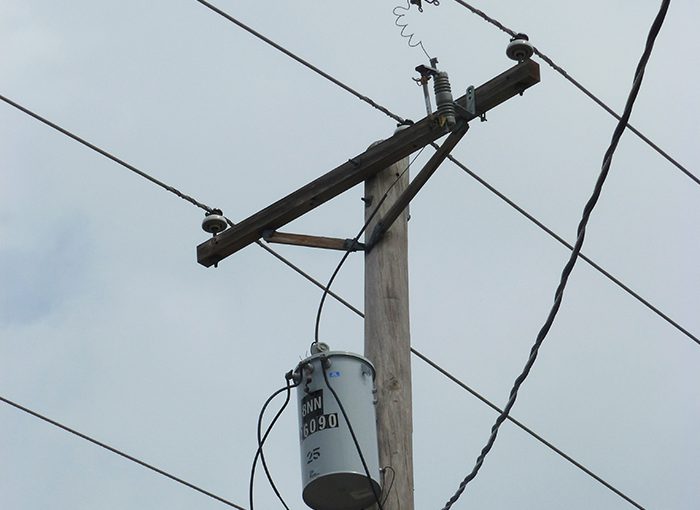
WHAT IS IT? An OPPD distribution power pole is typically made of southern yellow pine. They range in length from 35 to 55 feet, with more than 10 percent of each pole buried in the ground.
In the above photo, a wooden crossarm supports three primary conductors (wires) at the top. Porcelain insulators prevent the primary voltage from traveling through the crossarm, down the pole to the wires below, or to the ground.
Grey-colored, pole-top “kettle” transformers like the one shown convert the 13,800-volt primary voltage to 120 volts and 240 volts for distribution to residential customers. (Commercial and industrial customers often receive higher voltages.)
The secondary conductor at the bottom sends the reduced voltage from pole to pole. “Service drop” lines, like the one that angles out of the top photo, provide power to individual customers.
Mounted on the right side of the crossarm is a fused cutout. If a short-circuit causes too much power to flow through this fuse, it opens to interrupt the flow of power. This protects the transformer from damage. The fused cutout also indicates a problem when line workers troubleshoot power outages.

Terry Zank is a contributor to The Wire and senior publications coordinator at OPPD. He and his wife, Melissa, have three sons, ages 12 to 23, and a shichon puppy. Terry coaches his youngest son’s YMCA soccer team, and plays in the OPPD racquetball league. In his spare time, Terry wishes he had some spare time.
View all posts by Terry Zank >